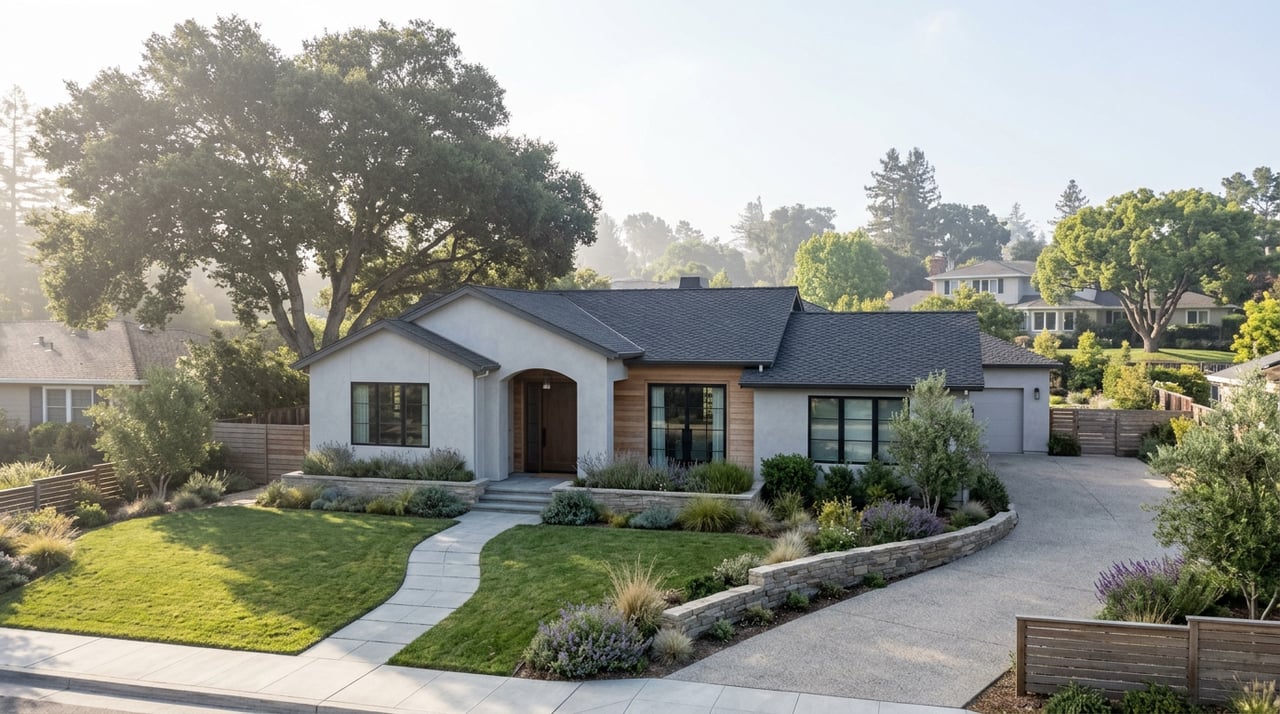
Rocklin's Newer Neighborhoods Can Sit on Bedrock. A Claypan Pocket Lies Beneath Its Oldest Core.
September 17, 2026
September 17, 2026
Picture a Saturday of home tours in Rocklin. The first stop is a two-story on a quiet Stanford Ranch street, oak canopy overhead, the kind of place that reads as settled. The second stop is a newer build in Whitney Ranch, on a graded pad that used to be part of a working quarry, the kind of place that sounds like it should come with foundation questions. Most buyers walk out of that second showing a little more cautious than they walked out of the first.
The soil survey says they had it backwards.
Rocklin incorporated in 1893, in the middle of a granite boom that eventually put 22 working quarries inside city limits by 1910. Stone cut here went into the California State Capitol and buildings across San Francisco. Mining continued in some form until 2005, when the last of the city's 62 historic quarries shut down. That history is baked into the name and into how people talk about the ground, and it produces a simple, understandable assumption: Rocklin sits on rock, so watch out for foundation trouble. You can read the full account on the City of Rocklin's own history pages, where the quarry story is treated as civic pride rather than a caution flag, which is closer to the truth than the folk version most buyers carry into a showing.
Soil mapping across Rocklin's master-planned pads tells a more specific story than "built on granite." Under much of Whitney Ranch, Whitney Oaks, Stanford Ranch, and Sunset West, bedrock sits shallow, roughly eleven to thirteen inches down, and the survey marks these as cut and fill areas where builders graded pads directly onto that stone. Shallow bedrock with low shrink-swell potential is close to the best possible base for a slab foundation. It does not heave with the wet-dry cycle the way clay-heavy valley soils do elsewhere in the region.
The one place in Rocklin where a soil survey actually flags real expansion risk is a mapped pocket of Cometa subsoil, with expansion potential starting eighteen to twenty-nine inches down, sitting under the city's oldest housing near downtown and the Quarry District. Those homes are more likely to sit on raised foundations rather than slab, which is itself a clue to the difference in ground conditions. Fewer than one percent of Rocklin's housing stock predates 1940, and the median home in the city was built around 2000, with roughly three quarters of the stock dating to 1990 or later. So the claypan risk touches a genuinely small share of homes, but it happens to sit under the exact streets that look and feel the most established.
| Area | Typical Construction Era | What's Actually Under the Pad |
|---|---|---|
| Whitney Ranch, Whitney Oaks, Stanford Ranch, Sunset West | 1990s to 2000s | Shallow bedrock, roughly 11 to 13 inches down, low shrink-swell, cut and fill |
| Downtown and Quarry District | Pre-1940, under 1% of citywide stock | Cometa claypan, real expansion potential starting 18 to 29 inches down, often raised foundations |
Foundation stability is not where Rocklin's granite past shows up in a real transaction. It shows up in the yard, specifically in what happens when a buyer wants a pool or a room addition.
Creative Edge Pools & Spas, a licensed contractor working across Whitney Ranch, Stanford Ranch, and Sunset, evaluates each lot and its neighbor history before quoting a job, because shallow granite exists in some pockets and not others even within the same subdivision. When rock is likely, they price the excavation contingency into the estimate up front rather than surprising a homeowner with a mid-dig change order. Custom pool builds in Rocklin generally start around $80,000 to $100,000, with rock excavation and other site conditions scaling the number from there. That is a meaningfully different budget conversation than a flat quote assumes, and it depends on the specific parcel, not the subdivision name.
A related wrinkle comes from how these communities were graded in the first place. Whitney Ranch and Stanford Ranch were built on engineered fill trucked in to level quarry-scarred terrain, and that fill drains differently than the native decomposed granite next to it. Two homes on the same cul-de-sac can sit on different ground, one on native rock and one on fill, without any visible difference at the surface. For a buyer planning a pool, patio, or addition, that is worth a direct question to a contractor rather than an assumption based on which master-planned community the listing falls under.
Not every Stanford Ranch risk traces back to granite. Many homes built there in the early to mid 1990s were plumbed with polybutylene pipe, a material known to deteriorate over time, and replacement typically runs $8,000 to $15,000 when it comes up in an inspection. It is a good reminder that "older, established neighborhood" carries its own era-specific questions, separate entirely from the soil story, and worth raising with a home inspector regardless of how solid the ground underneath feels.
Rocklin's citywide median sale price ran around $691,000 over the three months ending in June 2026. Whitney Ranch trades at a real premium above that citywide number, and part of the gap follows the Whitney High School attendance boundary, which recent local buyer data puts at a $25,000 to $50,000 premium over comparable homes elsewhere in the city. Buyers weighing Whitney Ranch against Stanford Ranch purely on that premium are pricing the school zone and the newer build year, and skipping a factor that shows up later: whether a specific lot sits on native bedrock or engineered fill, and what that means for a future pool quote or plumbing question.
I live in Whitney Oaks myself, on ground that carries the same quarry-era history as the rest of the city, and the pattern holds up from the inside. The subdivision name tells you the era. It does not tell you what a specific lot will cost to dig into.
Does shallow bedrock under a lot affect resale value or insurance? Not on its own. It is a known, mapped condition that local contractors already price around routinely. Where it matters is in future project budgets, not in the sale itself.
Should I get a soil or geotechnical report before buying in Rocklin? For a standard resale purchase with no yard project planned, it is not typical practice citywide. If you are buying with a pool, addition, or major hardscape already in mind, or if the property sits in the older core near downtown or the Quarry District where the claypan is mapped, asking a contractor to assess the specific lot before you finalize plans is the more useful step than a blanket geotechnical report.
Is decomposed granite the same thing as the bedrock everyone talks about? No. Decomposed granite is a loose, weathered material commonly used for pathways, patios, and drainage in Rocklin yards. The bedrock that shows up in excavation quotes is the solid rock underneath it, at a depth that varies by lot.
If you are comparing Rocklin neighborhoods and want the ground-level version of this conversation applied to a specific address, that is exactly the kind of question I help buyers work through before they write an offer. Kacey Wake has spent nearly two decades in these communities and can walk you through what a particular lot is actually sitting on. Let's Connect.
This article is general information, not legal, tax or financial advice. Consult a qualified professional about your situation.
Stay up to date on the latest real estate trends.
Whether you're buying, selling, or investing, Kacey provides personalized guidance, market expertise, and dedicated support to help you achieve your real estate goals with confidence.
Kacey Wake| CA DRE# 01429348
Compass California II, Inc. | CA DRE# 01527235
[email protected]
(916) 671-0233
2999 Douglas Blvd Ste 140 Roseville, CA 99691